Ear vs. Neck: The Complete Guide to Choosing Your Vagus Nerve Stimulation Method
Auricular or cervical? Which non-invasive VNS approach is right for your specific needs
Research Source: Frontiers in Neuroscience 2020, Clinical tVNS Studies
Reading Time: 9 minutes
Key Topics: Transcutaneous VNS comparison, auricular vs cervical, device selection guide
100,000+ patients have benefited from transcutaneous VNS worldwide
You're ready to try vagus nerve stimulation, but you're faced with a choice: stimulate through your ear or through your neck? Both approaches promise the benefits of VNS without surgery, but they work differently, feel different, and are suited to different conditions and lifestyles.
The decision matters. Choose the wrong method, and you might conclude that "VNS doesn't work for me" when the reality is that you simply chose the wrong delivery method for your specific situation. This comprehensive guide will help you make an informed decision based on science, not marketing.
The Two Pathways to Your Vagus Nerve
To understand the difference between ear and neck stimulation, we need to look at vagus nerve anatomy. The vagus nerve has multiple branches, and two of them are accessible from the body's surface:
The Auricular Branch (Ear)
The auricular branch of the vagus nerve — also called Arnold's nerve — is a small sensory branch that innervates parts of your outer ear. It carries sensory information FROM the ear TO the brain, joining the main vagus nerve trunk in the jugular foramen before descending to the brainstem.
What it innervates:
Cymba concha (the hollow above your ear hole)
Concha (the hollow below your ear hole)
Tragus (the little projection in front of your ear canal)
Posterior external auditory canal
Small patch of skin behind the ear
Key characteristic: This is purely a SENSORY branch. It carries information from the ear to the brain, not commands from the brain to the body. When you stimulate the auricular branch, you're activating afferent (sensory) fibers that project to the nucleus tractus solitarius in the brainstem — the same target as implanted cervical VNS.
The Cervical Branch (Neck)
The cervical vagus nerve is the main trunk of the nerve as it descends through your neck toward your chest and abdomen. This is the same nerve targeted by implanted VNS devices. It's a mixed nerve containing:
Afferent (sensory) fibers: 80% of the nerve — carrying information TO the brain
Efferent (motor) fibers: 20% of the nerve — carrying commands FROM the brain to organs
Key characteristic: This is the FULL vagus nerve — both incoming and outgoing traffic. Stimulating here activates the same fibers as implanted VNS, including both the sensory pathways to the brain AND the motor pathways that control your heart, lungs, and digestive tract.
How Each Method Works
Auricular VNS (taVNS)
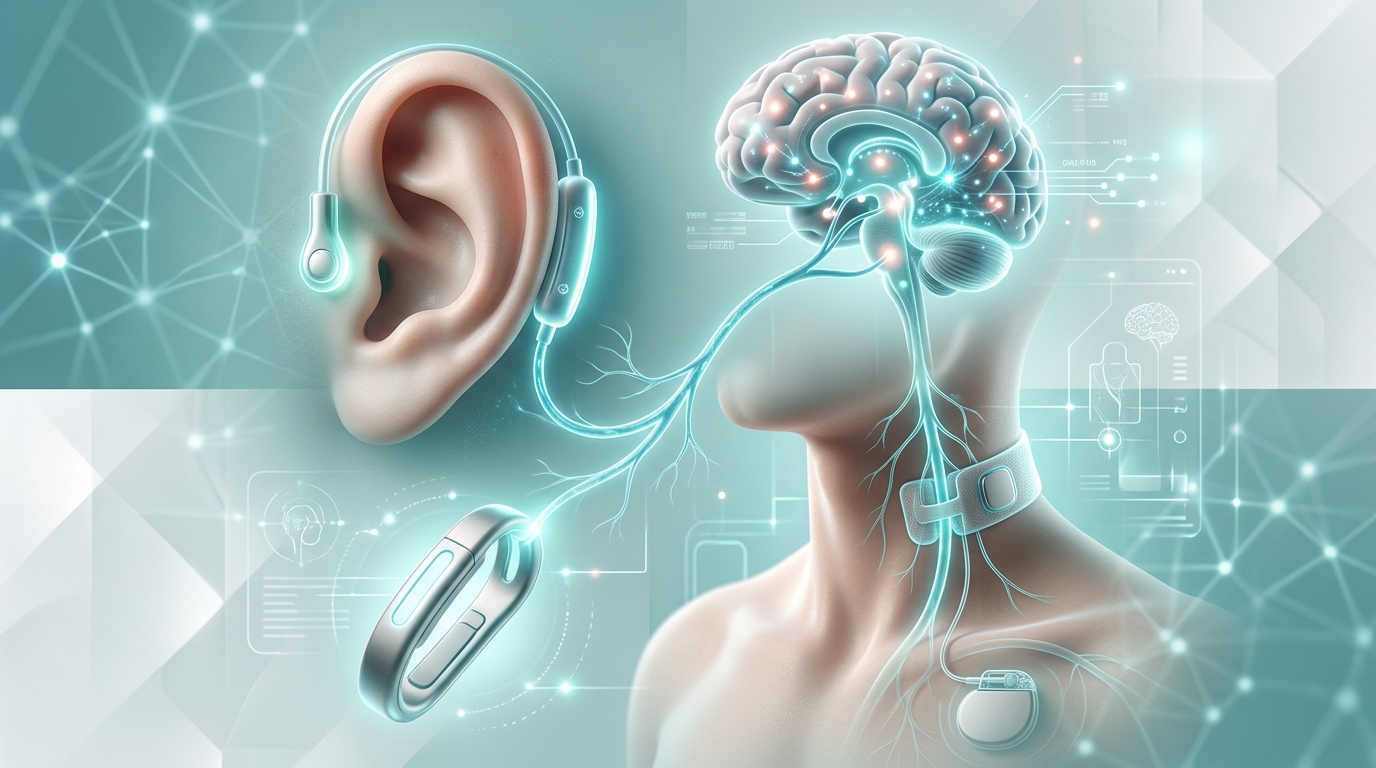
Auricular VNS uses small electrodes placed on or in the ear to stimulate the auricular branch. The electrical signal travels along the sensory fibers to the brainstem, where it activates the same networks targeted by implanted VNS.
Common Devices:
NEMOS: Earbud-style device for the cymba concha (prescription, Europe)
TENS ear clips: Various manufacturers, over-the-counter
gammaCore: Multi-use device that can target ear or neck
What you feel: A mild tingling sensation in the ear, sometimes described as "buzzing" or "pulsing." The sensation should be noticeable but not uncomfortable.
Cervical VNS
Cervical VNS places surface electrodes on the neck over the carotid sheath where the vagus nerve runs. The electrical current penetrates through skin and tissue to reach the nerve trunk.
Common Devices:
gammaCore: FDA-cleared handheld device for headache/migraine (neck placement)
TENS units with neck electrodes: Various configurations
Research devices: Custom setups with ultrasound guidance
What you feel: Tingling, tapping, or vibrating sensations in the neck. At higher intensities, you may feel a slight pulling sensation in the throat or mild voice changes during stimulation.
Head-to-Head Comparison
Factor Auricular VNS Cervical VNS Target Auricular branch (sensory only) Cervical trunk (mixed nerve) Strength of activation Moderate (indirect) Strong (direct) Consistency Variable (ear anatomy differs) More consistent Comfort Generally comfortable Can cause throat sensations Side effects Minimal Voice changes, cough possible Cost $200-$500 typical $200-$600 typical Discretion Very discreet (earbud) Visible on neck Session length 15-60 minutes 2-5 minutes (gammaCore) to 30 min FDA clearance Limited gammaCore cleared for headache
What the Research Shows
Brain Activation Patterns
fMRI studies comparing auricular and cervical tVNS reveal both similarities and differences:
Both activate:
Nucleus tractus solitarius (NTS) — the main brainstem target
Locus coeruleus — norepinephrine center linked to arousal and attention
Amygdala — emotional processing center
Hypothalamus — autonomic control center
Insula — interoception and body awareness
Cervical shows stronger activation: Studies consistently find that cervical stimulation produces more robust and widespread brain activation compared to auricular stimulation. This makes sense — you're stimulating the full nerve trunk rather than a small sensory branch.
Autonomic Effects
Both approaches affect the autonomic nervous system, but cervical stimulation generally produces more pronounced effects:
Measure Auricular VNS Cervical VNS Heart Rate Variability (HRV) increase 5-15% improvement 10-30% improvement Heart rate decrease Mild (2-5 bpm) Moderate (5-15 bpm) Blood pressure reduction Small effect Moderate effect Sympathetic inhibition Present More pronounced
Clinical Applications: Which for Which Condition?
Best for Auricular VNS:
1. General Wellness and Stress Management
For daily relaxation, stress resilience, and general health optimization, auricular VNS is ideal. The comfort and convenience make it easy to incorporate into daily routines.
2. Mild Anxiety
For situational anxiety or mild generalized anxiety, the gentler activation of auricular VNS is often sufficient. The discreet nature also makes it useful for use during work or social situations.
3. Sleep Improvement
Evening auricular VNS sessions can promote parasympathetic dominance and prepare the body for sleep without the stronger effects that might cause throat sensations.
4. Focus and Cognitive Enhancement
The locus coeruleus activation from auricular VNS supports attention and cognitive performance, making it suitable for students, professionals, or anyone seeking cognitive optimization.
5. Patients Uncomfortable with Neck Stimulation
If you find neck stimulation unpleasant or experience significant throat sensations, auricular VNS provides an effective alternative.
Best for Cervical VNS:
1. Migraine and Cluster Headache
The gammaCore device is FDA-cleared specifically for headache disorders using cervical stimulation. The stronger activation appears more effective for acute headache termination and prevention.
2. Treatment-Resistant Depression
For moderate to severe depression where implanted VNS is being considered, cervical tVNS offers a non-invasive trial. The direct nerve trunk activation more closely mimics implanted VNS.
3. Epilepsy Adjunctive Therapy
While not a replacement for medication, cervical VNS as adjunctive therapy may help reduce seizure frequency in some patients.
4. Inflammatory Conditions
The efferent (motor) fibers in the cervical vagus control the inflammatory reflex. For rheumatoid arthritis, inflammatory bowel disease, or other inflammatory conditions, cervical stimulation is theoretically superior.
5. Acute Symptom Management
When you need rapid, strong effects — such as stopping a panic attack or aborting a migraine — cervical stimulation's more robust activation is advantageous.
Practical Considerations
Getting Started: Auricular VNS
Typical Protocol:
Place electrodes on the tragus, concha, or cymba concha
Start with low intensity (tingling but comfortable)
Session duration: 15-60 minutes
Frequency: Daily or twice daily
Common settings: 25 Hz, 200-300 μs pulse width
Tips for Success:
Clean the ear area before applying electrodes
Ensure good contact — poor contact causes uneven sensation
If sensation is uncomfortable, try different ear locations
Some users prefer the cymba concha; others prefer the tragus
Experiment with timing (morning for alertness, evening for relaxation)
Getting Started: Cervical VNS
Typical Protocol:
Locate the carotid pulse in the neck
Move laterally (toward the outside) toward the sternocleidomastoid muscle
Place electrodes over the carotid sheath area
Start with low intensity and increase gradually
Session duration: 2-5 minutes (gammaCore) to 30 minutes
Frequency: As needed for acute symptoms, or daily for prevention
Tips for Success:
Proper positioning is critical — use anatomical landmarks or ultrasound guidance
Avoid stimulating over the carotid sinus (can cause blood pressure drops)
Mild voice changes during stimulation are normal; stop if uncomfortable
Shave or trim neck hair for better electrode contact
Use conductive gel for better current transmission
The Hybrid Approach
Some clinicians and patients are now using both methods strategically:
Daily Prevention: Auricular VNS for daily wellness, stress management, and baseline vagal tone improvement.
Acute Intervention: Cervical VNS for breakthrough symptoms, acute anxiety, or impending migraine.
This combination leverages the convenience and comfort of auricular stimulation for routine use while maintaining the stronger effects of cervical stimulation when needed.
Making Your Decision
Choose Auricular VNS If:
You want gentle, comfortable daily stimulation
Discretion is important (work, social situations)
Your primary goals are stress management, sleep, or general wellness
You prefer longer, gentler sessions
You found neck stimulation uncomfortable
You have mild anxiety or want cognitive enhancement
Choose Cervical VNS If:
You have moderate to severe symptoms (depression, migraine)
You need rapid, strong effects for acute symptoms
You're considering implanted VNS and want a non-invasive trial
You have inflammatory conditions
You want the closest non-invasive equivalent to implanted VNS
Shorter, more intense sessions fit your lifestyle better
The Bottom Line
Neither approach is universally "better" — they're different tools for different situations. Auricular VNS offers convenience, comfort, and discretion for daily wellness applications. Cervical VNS provides stronger, more direct activation suited to therapeutic applications and acute symptom management.
The good news? Both are safe, non-invasive, and backed by growing research. You can start with one, try the other, or use both strategically. The vagus nerve is accessible from multiple points, and the right approach is the one that fits your body, your lifestyle, and your specific health goals.
Key Takeaways:
Auricular VNS stimulates a sensory branch through the ear — gentler and more comfortable
Cervical VNS stimulates the main nerve trunk through the neck — stronger and more direct
Cervical stimulation produces more robust brain activation and autonomic effects
Auricular VNS is ideal for wellness, mild anxiety, sleep, and daily use
Cervical VNS is better for headaches, depression, epilepsy, and acute symptoms
Some patients benefit from combining both approaches
Both are safe — the right choice depends on your specific needs and goals
"The vagus nerve is the highway, but you can enter through different on-ramps. Whether you choose the ear or the neck, you're accessing the same powerful pathway to better health."