What If Healing Your Nervous System Didn't Require Cutting Into Your Body?
The endovascular revolution that's changing everything we thought we knew about vagus nerve stimulation
Picture this: You're dealing with chronic health issues—maybe it's epilepsy that won't respond to medication, or depression that medication barely touches. Your doctor mentions something called vagus nerve stimulation, and then hits you with the reality check: We need to cut open your neck, dissect a major nerve away from your artery, and wrap an electrode around it.
Sound intimidating? That's because it is. Traditional vagus nerve stimulation (VNS) surgery has helped thousands of people, but let's be honest—the thought of someone dissecting a nerve in your neck is enough to make anyone's palms sweat.
But what if I told you there's a new approach that could achieve the same results—without anyone touching your vagus nerve at all?
The Game-Changer: Stimulating From the Inside Out
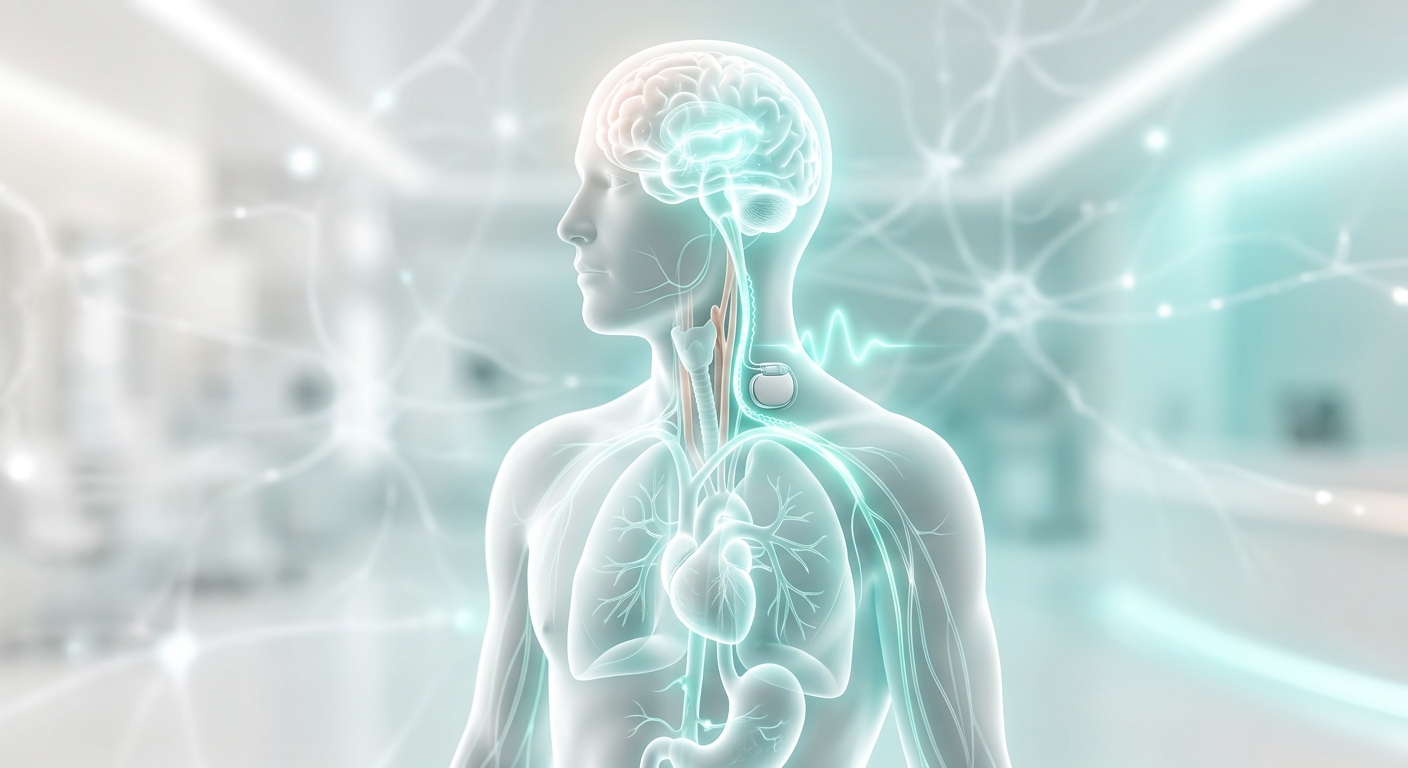
Researchers have developed something remarkable, and it's about to flip the script on how we treat neurological conditions. It's called endovascular VNS, and instead of cutting open your neck and handling your nerves like a delicate piece of wiring, doctors can now slide an electrode into a vein in your neck and stimulate the vagus nerve from the inside.
Yes, you read that right. From inside your vein.
The magic happens in your internal jugular vein (IJV)—that big vein running up the side of your neck. Using minimally invasive techniques similar to placing a stent, physicians thread an electrode array into the vein. Once positioned, it delivers electrical impulses that travel through just a few millimeters of tissue to reach the vagus nerve.
No nerve dissection. No delicate separation of nerve from artery. No extensive recovery from neck surgery.
Why Your Neck's Anatomy Makes This Possible
Here's where it gets fascinating. Your body has already done the hard work of bundling everything together in what's called the carotid sheath—a protective wrapping that houses three crucial structures running parallel up your neck:
- The internal jugular vein on the outside (lateral)
- The common carotid artery on the inside (medial)
- Your vagus nerve tucked right in between them
Here's the kicker: your vagus nerve and that internal jugular vein are separated by mere millimeters of tissue. It's like they're neighbors sharing a very thin wall. When doctors place an electrode inside the vein and send an electrical pulse, that signal easily travels across to stimulate the nerve.
Nature packed these structures together for protection. Now we're using that same proximity to heal—without the trauma of traditional surgery.
The Benefits That Actually Matter to You
Let's talk about what this actually means for real people facing real decisions about their health:
No More Nerve Dissection
Traditional VNS requires surgeons to carefully dissect the vagus nerve away from the carotid artery—a procedure that carries inherent risks. One slip, and you're dealing with vascular complications. Endovascular VNS eliminates this risk entirely because the nerve never gets touched.
Faster Recovery, Less Trauma
Instead of a surgical incision in your neck and the recovery that comes with it, you're looking at a minimally invasive procedure. Less surgical trauma means less pain, shorter hospital stays, and getting back to your life faster.
Reaching the Unreachable
Traditional surgery can only access certain portions of the vagus nerve. Some locations are simply too risky or impossible to reach with open surgery. Endovascular approaches can potentially target vagus nerve locations that were previously off-limits—opening up treatment possibilities for more patients.
Fewer Side Effects
Here's something especially promising: this approach may be able to stimulate therapeutic nerve fibers while avoiding motor fiber activation. Translation? You might get all the benefits with fewer of the side effects—like voice changes or throat sensations—that sometimes trouble traditional VNS patients.
The Science Behind the Breakthrough
This isn't science fiction, and it's not theoretical. Research published in the Journal of Neural Engineering (2023) by Nicolai and colleagues has demonstrated the viability of endovascular electrode arrays for cervical vagus nerve stimulation.
The technology leverages decades of advances in endovascular procedures—think cardiac stents and similar interventions that have become routine. By adapting these techniques for neuromodulation, researchers have created a pathway to VNS that's safer, less invasive, and potentially more precise.
What This Means for the Future of Healing
We've all watched medical technology evolve at breakneck speed. Procedures that once required major surgery now happen through tiny incisions—or no incisions at all. Endovascular VNS represents the next step in that evolution for neurological treatment.
For the millions of people living with treatment-resistant epilepsy, depression, and other conditions that respond to vagus nerve stimulation, this could be transformative. The barrier to entry—the fear of invasive neck surgery—that keeps many patients from pursuing VNS may finally be coming down.
The Takeaway: Less Invasive, More Hopeful
The story of endovascular VNS is really a story about working with the body's design instead of against it. Instead of cutting through tissue and dissecting delicate structures, we're threading carefully through the pathways nature already provided.
If you or someone you love has been considering vagus nerve stimulation but hesitated at the thought of traditional surgery, keep your eyes on this space. The future of VNS isn't about bigger incisions and more invasive procedures—it's about precision, minimal disruption, and letting the body's own anatomy do the heavy lifting.
Sometimes the most profound medical breakthroughs don't come from doing more—they come from doing less, more cleverly.
Source: Nicolai et al., Journal of Neural Engineering, 2023. Endovascular Neuromodulation Research: Endovascular electrode array for cervical vagus nerve stimulation.
' )