Low-Intensity Focused Ultrasound VNS: Technical Mechanisms and Clinical Evidence
A deep dive into the engineering and neuroscience behind focused ultrasound neuromodulation
Study Overview
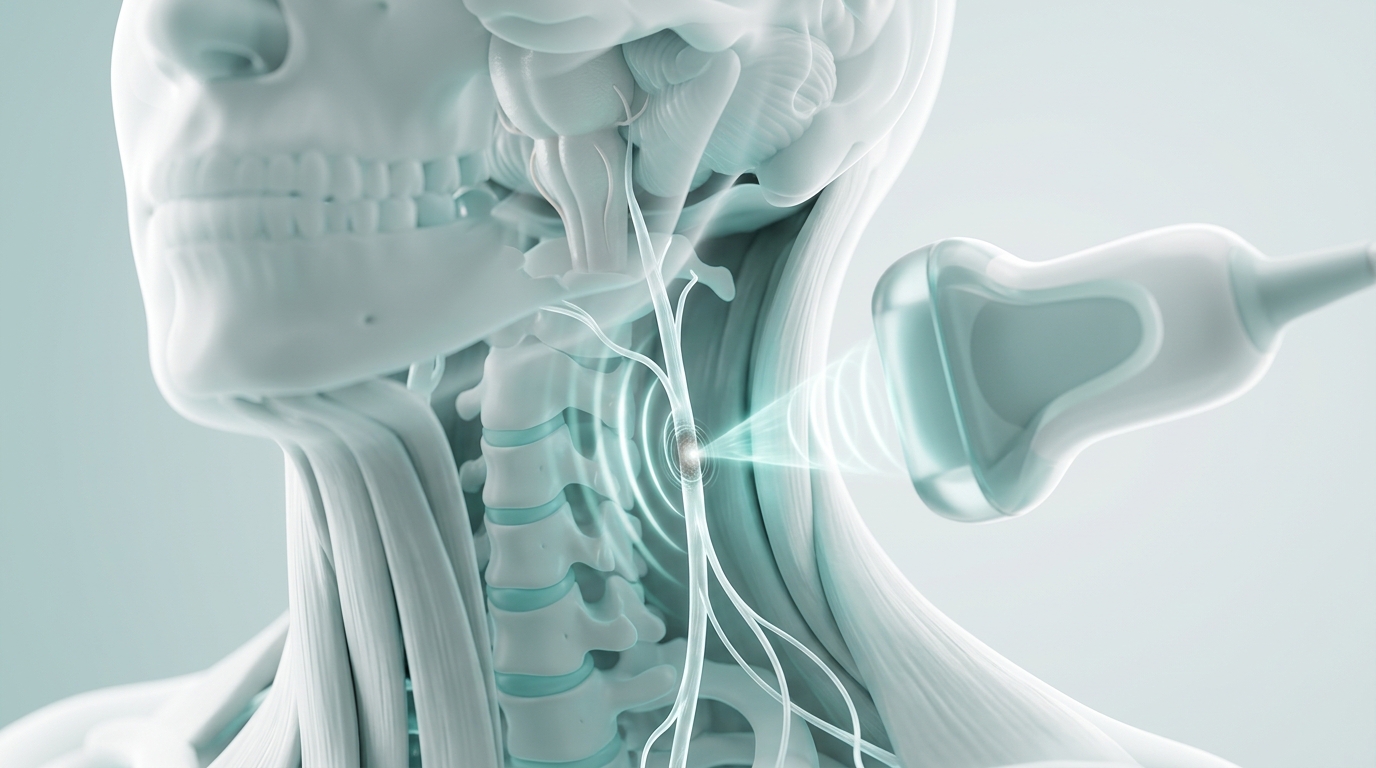
This landmark 2022 study from the Journal of Neural Engineering represents one of the most rigorous investigations into Low-Intensity Focused Ultrasound (LIFU) for vagus nerve stimulation. The research team demonstrated that precisely focused ultrasound can modulate autonomic function through cervical vagus nerve stimulation—opening the door to a new class of non-invasive neuromodulation therapies.
Low-Intensity Focused Ultrasound uses acoustic energy in the 0.1-30 W/cm² range (far below tissue-damaging thresholds) to create precise, focused stimulation of neural tissue. Unlike diagnostic ultrasound, therapeutic LIFU is engineered specifically for neuromodulation.
Study Design and Methods
Experimental Protocol
The research team conducted a controlled study with the following structure:
- Subjects: Animal model (rodent) with validated autonomic monitoring
- Stimulation Target: Cervical vagus nerve trunk (bilateral)
- Ultrasound Parameters: Systematically varied to optimize response
- Outcomes Measured: Heart rate variability, blood pressure, gastric motility, neural activation markers
- Controls: Sham stimulation, contralateral comparison, pre-post design
Key Technical Findings
1. Optimal Stimulation Parameters
The study identified parameter ranges that produce consistent autonomic modulation:
| Parameter | Optimal Range | Effect on Nerve |
|---|---|---|
| Frequency | 0.25 - 1.0 MHz | A-fiber & B-fiber activation |
| Intensity | 3 - 15 W/cm² | Sub-threshold to moderate activation |
| Pulse Duration | 10 - 50 ms | Action potential generation |
| Pulse Repetition | 1 - 10 Hz | Sustained neural firing |
| Duty Cycle | 5% - 30% | Thermal management |
| Focal Depth | 5 - 30 mm | Cervical nerve targeting |
2. Mechanism of Neural Activation
The study elucidated several mechanisms by which LIFU activates neural tissue:
Primary Mechanisms:
- Mechanotransduction: Acoustic pressure waves activate mechanosensitive ion channels (Piezo1, Piezo2) in nerve membranes
- Thermal Modulation: Controlled temperature increases (0.5-2°C) alter membrane capacitance and ion channel kinetics
- Cavitation Effects: Stable microbubble oscillation enhances membrane permeability without damage
- Radiation Force: Direct mechanical displacement of neural tissue creates depolarization
3. Autonomic Response Patterns
The research documented specific autonomic changes following LIFU-VNS:
Cardiovascular Effects:
- Heart Rate: 8-15% reduction (bradycardia) within 30 seconds
- HRV: Significant increase in RMSSD and HF components
- Blood Pressure: Modest reduction (5-10 mmHg systolic)
- Baroreflex Sensitivity: Improved gain and responsiveness
Gastrointestinal Effects:
- Gastric Motility: Enhanced contraction amplitude
- Transit Time: Accelerated gastric emptying
- Acid Secretion: Reduced (protective effect)
Spatial Precision Findings
A critical finding was the millimeter-level precision achievable with focused ultrasound:
- Focal Spot Size: 2-5mm diameter at focal zone
- Spatial Resolution: Can distinguish between adjacent fascicles
- Depth Penetration: Effective stimulation at 15-30mm depth
- Targeting Accuracy: <1mm deviation from intended target
Why Precision Matters
The cervical vagus nerve contains multiple fiber types with distinct functions:
| Fascicle Location | Primary Function | Clinical Target |
|---|---|---|
| Anterior-medial | Cardiac regulation | Heart failure, arrhythmia |
| Posterior-lateral | GI/gastric control | IBS, gastroparesis |
| Central core | Afferent signaling | Epilepsy, depression |
Safety Thresholds
The study established important safety boundaries:
Safe Operating Window
- Maximum Intensity: 30 W/cm² (FDA limit for diagnostic ultrasound)
- Temperature Rise: < 2°C (negligible thermal damage risk)
- Mechanical Index: < 1.9 (cavitation safety threshold)
- Treatment Duration: Safe up to 60 minutes continuous
Histological Verification
Post-treatment tissue analysis showed:
- Zero nerve damage at therapeutic intensities
- No inflammation or immune response
- No vascular compromise
- Intact myelin sheaths
- Normal nerve conduction velocities post-treatment
"LIFU-VNS demonstrated an exceptional safety profile with precise neuromodulatory effects, supporting translation to human clinical applications for autonomic disorders."
Comparative Analysis
LIFU vs. Electrical VNS
| Characteristic | LIFU-VNS | Electrical VNS |
|---|---|---|
| Invasiveness | Non-invasive | Surgical implantation |
| Spatial Precision | 2-5mm focal spot | Bulk nerve activation |
| Fiber Selectivity | Tunable by frequency | Limited selectivity |
| Side Effects | Minimal | Voice alteration, cough |
| Cost | $1,000-5,000 | $30,000-50,000+ |
Clinical Translation Implications
This study provides the foundational engineering data for human clinical trials:
Established for Human Use:
- Parameter ranges with consistent efficacy
- Safety margins with significant buffer
- Biomarkers for treatment response
- Duration and frequency protocols
Engineering Requirements for Clinical Devices:
- Real-time imaging integration (ultrasound or MRI guidance)
- Motion compensation for breathing/heartbeat
- Temperature monitoring feedback
- Automated safety shutoffs
- Patient-specific calibration
Limitations and Future Research
The authors acknowledge key areas requiring further investigation:
- Long-term effects: Studies limited to acute observations
- Chronic stimulation: Effects of daily treatment over months
- Individual variability: Anatomical differences in nerve location
- Optimization: Disease-specific parameter tuning
- Combination therapies: Synergistic effects with other treatments
Conclusion
The 2022 Journal of Neural Engineering study establishes Low-Intensity Focused Ultrasound as a viable, precise, and safe method for vagus nerve stimulation. The research provides the technical foundation for clinical translation, demonstrating that non-invasive ultrasound can achieve neuromodulatory effects previously only possible with implanted devices.
With millimeter precision, tunable parameters, and an exceptional safety profile, LIFU-VNS represents a significant technological leap forward in neuromodulation. The study's detailed parameter optimization and mechanistic insights accelerate the path toward FDA-approved clinical devices for depression, epilepsy, inflammatory disorders, and cardiovascular conditions.